
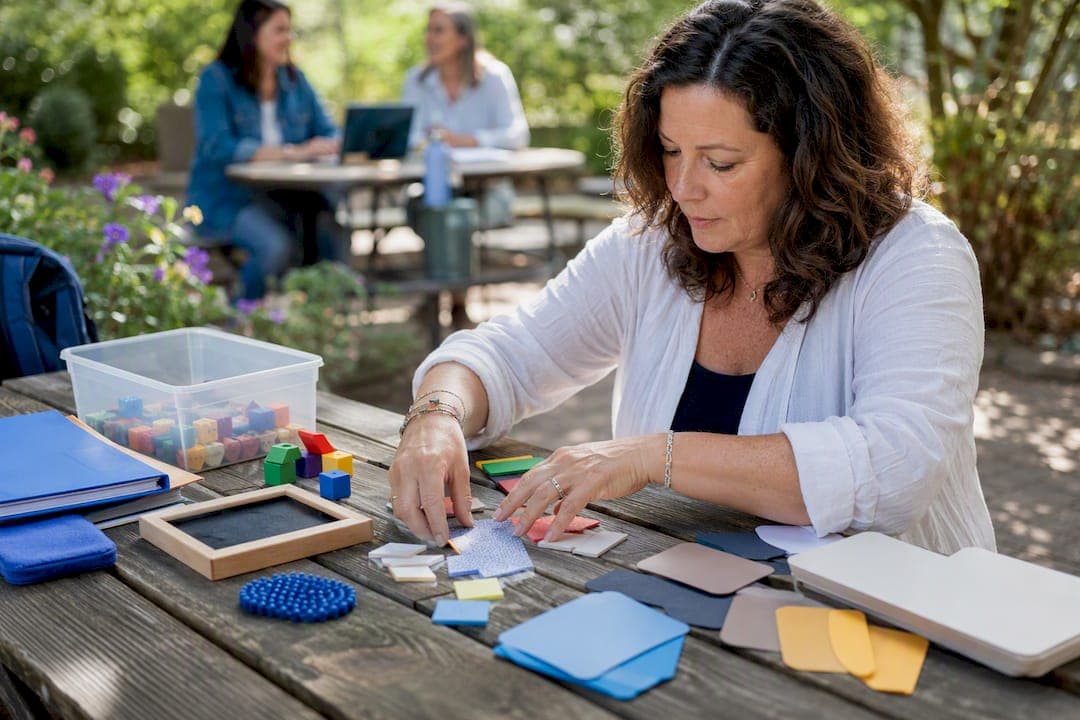
Start with a tight learning goal, then anticipate learner variability before you plan a single activity. Once you know the goal and the likely barriers, build in flexible options for engagement, representation, and expression rather than writing one lesson and patching it later. This is the core of udl lesson planning: design for variability up front, using the CAST UDL Guidelines as your checkpoint reference and a tool like Letsmakeai to draft options fast.
Mini-template to copy right now:
- Goal: What should every student know or do by the end?
- Barrier check: What might block access (language, prior knowledge, sensory, executive function)?
- Three flexible options: One each for engagement, representation, action/expression.
- Assessment choice: At least two ways students can show mastery.
Next steps:
- Write your goal in plain language before touching activities.
- Pick one barrier to address today, not five.
- Draft one flexible option per UDL principle.
Key Takeaways
Effective UDL lesson planning follows a fixed sequence: clarify the goal, anticipate barriers, build flexible options across all three principles, then reflect and redesign after teaching.
| Point | Details |
|---|---|
| Start with the goal | Write a tight, plain-language learning goal before choosing any activity. |
| Anticipate barriers first | Use formative data and observation notes to predict who will struggle where. |
| Map to three principles | Build at least one flexible option each for engagement, representation, and expression. |
| Reflect in three windows | Check in right after class, at day's end, and weekly, then make one redesign change. |
| Speed up drafting with AI | Tools like Letsmakeai's HomeworkHelper can draft lesson options and rubrics in minutes for teachers who want a faster starting point. |
Table of Contents
- What Does UDL Lesson Planning Actually Involve?
- How Do You Turn UDL Principles Into Classroom Strategies?
- When Should You Reflect and Redesign a UDL Lesson?
- Copyable UDL Lesson Plan Template You Can Use Today
- Which Resources Should You Actually Bookmark?
- Sources
What Does UDL Lesson Planning Actually Involve?
UDL lesson planning is a three-stage cycle: proactive design, implementation, and reflection with redesign, and it starts before you ever step in front of students, according to Understood.org's guidance on UDL lesson planning. The first stage is where most of the real work happens.
Step 1: Design the lesson before you teach it
Unpack your standard into a single, tight goal, separate from the how. If your standard covers analyzing a historical cause and effect, your goal might be "students will explain how one event caused another," not "students will complete the worksheet." Write a student-facing "I can" statement from that goal so learners know exactly what success looks like.

TEA's UDL implementation guidance recommends clarifying that purposeful goal first, then anticipating and removing barriers by adjusting methods, materials, and assessments, not the goal itself.
Run through these before finalizing anything:
- What's the one thing every student must walk away knowing or doing?
- Which barriers are most likely: unfamiliar vocabulary, thin background knowledge, attention or working-memory demands, sensory access?
- What parts of this lesson can flex (materials, grouping, output) versus what must stay fixed (the goal)?
- What does my formative data already tell me about who will struggle where?
Pull evidence from exit tickets, screener results, or last week's observation notes rather than guessing. Experienced UDL practitioners treat learner variability as the constant, not the exception, which is why this step comes before any activity gets built.
How Do You Turn UDL Principles Into Classroom Strategies?
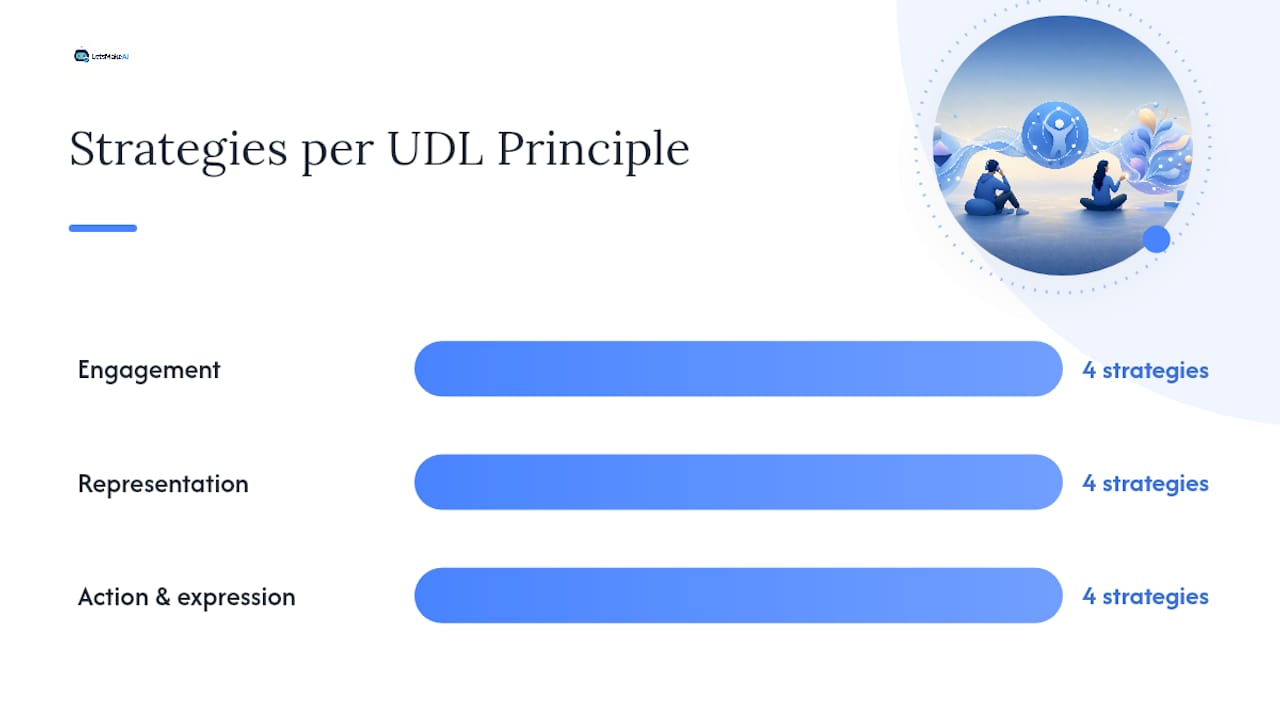
Once the goal and barriers are clear, map your strategies to the three UDL principles: engagement (the why), representation (the what), and action & expression (the how), following the structure in CAST's UDL Guidelines.
Engagement strategies:
- Offer a choice of topics or contexts within the same task.
- Connect the lesson to a real, current issue students care about.
- Build in low-stakes checkpoints so anxiety doesn't block participation.
- Vary group size: some tasks solo, some paired, some whole-class.
Representation strategies:
- Pair text with images, audio, or short video for the same content.
- Pre-teach key vocabulary using visuals, not just definitions.
- Provide graphic organizers alongside written instructions.
- Record instructions so students can replay them.
Action & expression strategies:
- Let students choose between writing, recording, or presenting.
- Use rubrics shared in advance so expectations are transparent, a practice backed by UGA's evidence-based teaching strategies.
- Offer scaffolded templates for students who need structure.
- Allow drafts or rehearsal before the final product counts.
Five quick vignettes:
- A sixth-grade science teacher lets students choose between a lab report, a diagram with captions, or a short video explaining osmosis, all graded against the same rubric.
- A high school English class reads a short story via text, audiobook, or graphic-novel adaptation, then discusses in mixed groups.
- An elementary math teacher offers manipulatives, number lines, or mental math strategies for the same word problem set.
- A middle school social studies unit gives students a choice of debate, poster, or podcast to argue a historical perspective.
- A community college writing instructor allows outlines, voice memos, or mind maps as prewriting before the essay draft.
Time and group size are real constraints. If you only have one class period, pick two strategies, not six, and reuse the choice menu across the unit instead of rebuilding it daily.
When Should You Reflect and Redesign a UDL Lesson?
Reflection works best in three quick windows: right after class while details are fresh, at the end of the day when you can compare periods, and at the end of the week when patterns across lessons show up.
Ask three questions each time:
- What did students say or show that told me the lesson worked (or didn't)?
- What did I notice during instruction that surprised me?
- What's the evidence, exit ticket, work sample, or quick poll, that backs this up?
Turn the answer into exactly one redesign item for next time, not a full overhaul. If half the class skipped the written reflection but engaged with the discussion prompt, that's your one change: build in an oral option next time. This matches the reflect-and-redesign stage in Understood.org's three-stage UDL process.
Copyable UDL Lesson Plan Template You Can Use Today
Copy this into your planner or LMS:
- Learning goal:
- Success criteria (I can statement):
- Barrier check (language, background knowledge, executive function, sensory):
- Flexible option, engagement:
- Flexible option, representation:
- Flexible option, action/expression:
- Assessment choices (at least two):
- Materials needed:
- Accommodations/supports:
Pre-teach checklist, run this before class:
- Goal is written in plain language and posted.
- At least one barrier has a planned workaround.
- Materials are ready in multiple formats.
- Assessment choices are explained to students, not just planned.
- Grouping decision is made, not improvised.
Sample filled template, middle school science: Goal: Explain how energy transfers in a food chain. Barrier check: unfamiliar vocabulary (producer, consumer). Engagement: students pick a local ecosystem to model. Representation: diagram plus short video. Action/expression: build a physical model or write a paragraph. Assessment: rubric covers accuracy, not format.
Which Resources Should You Actually Bookmark?
The CAST UDL Guidelines are the primary checkpoint reference, use them when filling in the "flexible options" section of your template. Katie Novak's UDL lesson planning protocol offers a step-by-step sequence, clarify purpose, anticipate variability, build a welcoming start, embed flexible assessments, plan for student ownership, which pairs well with the template above. The TEA implementation guide is strongest for standards alignment and rubric language.
Beyond those, look for accessible content platforms with built-in captioning, visual organizer tools, and text-to-speech options. Save AI brainstorming for generating draft choice menus or rubric language, not for making individualized accommodation decisions.
Research-backed tip: save planning time without losing UDL quality
Build reusable choice menus and a modular activity bank once, then adapt them lesson to lesson instead of starting fresh. Novak's protocol points to this kind of reuse as the key to preserving rigor while cutting planning time. Use AI to draft rubric language or brainstorm options, never to decide an individual student's accommodations without your own professional judgment.
The goal isn't a different lesson for every student. It's designing enough flexibility into one lesson that fewer individual workarounds are needed at all.
Pro Tip: Keep a running "options bank" by unit, three engagement hooks, three representation formats, three expression choices, so each new lesson starts as a remix, not a rebuild.
First-person note from an educator who used this workflow
"Once I built my choice menus ahead of time, I spent less time managing off-task behavior and more time actually looking at what students produced."
If you want to speed UDL lesson planning: a practical option
Building flexible options for every lesson takes real time, and most teachers are doing it on top of grading and parent emails. Letsmakeai's HomeworkHelper generates lesson-plan drafts, rubric language, and differentiation suggestions in minutes instead of hours, then exports straight to your LMS.
- Draft engagement, representation, and expression options for a lesson without starting from a blank page.
- Generate rubrics aligned to your assessment choices in seconds, not an evening.
- Export to your LMS so the template above becomes a working document, not a static file.
If your planning time is the bottleneck standing between you and a genuinely flexible lesson, try HomeworkHelper's free trial and see how fast a UDL-aligned draft comes together.
Sources
- The UDL Guidelines — CAST
- Understood
- UDL Implementation Guide for Educators in Texas — TEA
- Universal design for learning — CTL, University of Georgia
- Novak UDL Lesson Planning Protocol 2025 — Novak Education
Do you need a different lesson plan for every student in UDL? No. UDL designs flexibility into one lesson so fewer individual accommodations are needed, not a separate plan per student.
How long does UDL lesson planning take once you have a template? Once you have a reusable choice menu and activity bank, most teachers report needing far less time per lesson than building from scratch.
What's the difference between UDL and differentiated instruction? Differentiated instruction adjusts a lesson for specific students after the fact; UDL builds flexibility into the design before you teach, reducing how much adjustment is needed later.
Which UDL principle should you start with if you're new to this? Start with representation, offering content in more than one format, since it's often the fastest change to make and shows immediate results.
Can AI tools replace UDL planning judgment? No. AI can draft options and rubric language quickly, but decisions about individual accommodations still require your professional judgment.